
Background
Alkali Environmental took over a biannual MCERTS stack emissions monitoring contract from a previous test house. The site operates under an Environment Agency environmental permit that requires periodic isokinetic stack emissions testing at multiple sample locations across the process. On reviewing the existing monitoring arrangements, our UKAS-accredited stack testing team flagged two problems with one of the inherited sample points that were quietly costing the operator money and increasing health-and-safety risk every visit.
Challenge
The legacy sample location was on an elevated section of ducting that could only be reached by working at height. Every monitoring visit — twice a year — required the client to hire a mobile access tower so the stack testing crew could safely access the sample port. That meant an ongoing equipment hire cost, additional method statement and risk assessment work, and an avoidable working-at-height exposure for our technicians and the site's own staff.
- Mobile access tower hire required for every biannual MCERTS stack test visit.
- Working at height exposure on a routine, repeatable monitoring task.
- The duct at this location was oversized for the gas flow, producing poor flow conditions and making it harder to achieve a representative isokinetic sample under BS EN 15259.
Solution
Our stack testing team carried out a sample point design review on the wider process duct system to identify an equivalent monitoring location that would give the same regulatory evidence without the work-at-height burden. We then recommended a relocated sample point in writing for the operator's engineering team.
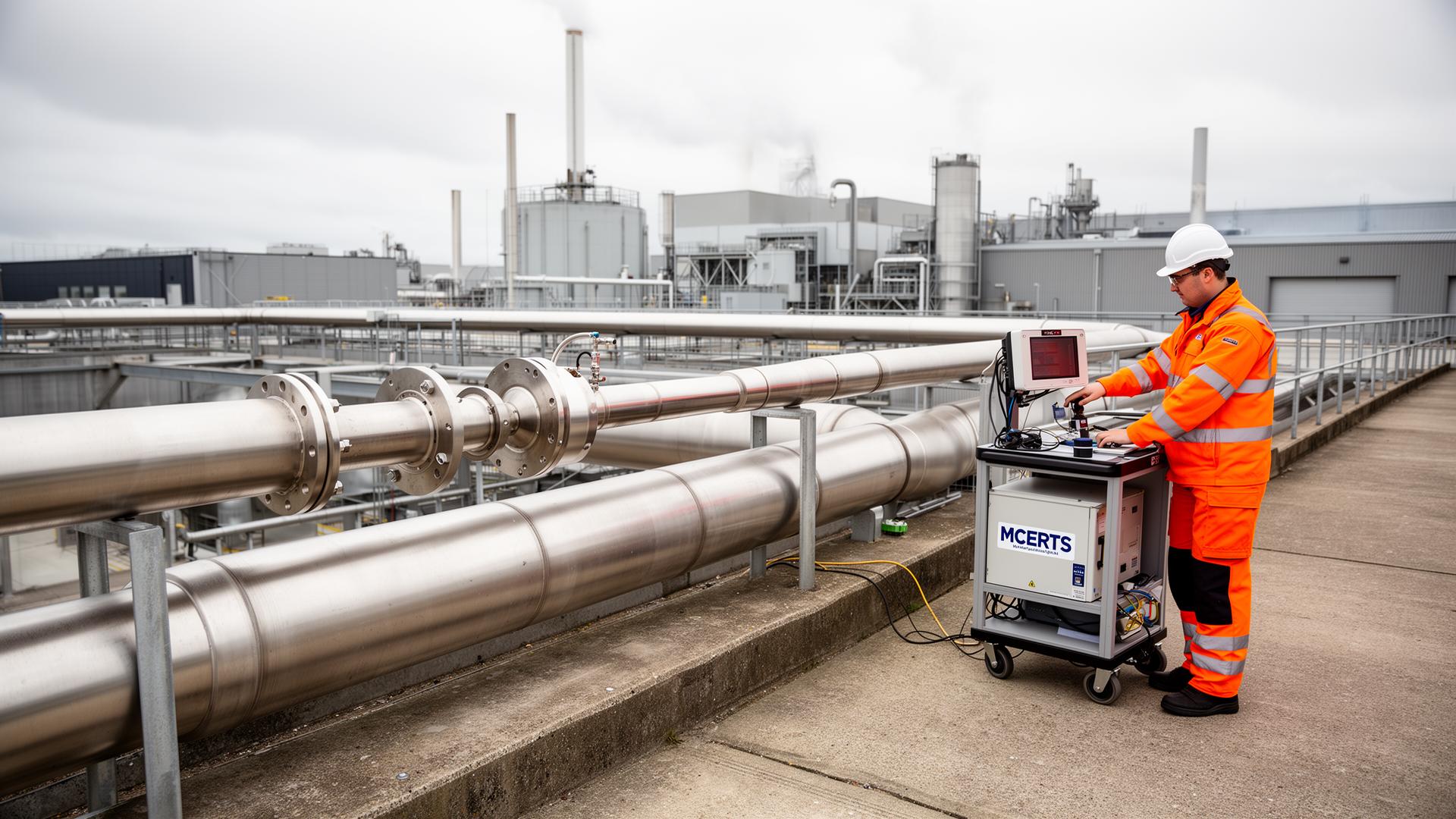
- Identified an equivalent ground-level sample location accessible from a safe concrete walkway — no mobile access tower required.
- Confirmed the new location satisfies BS EN 15259 straight-length and flow homogeneity requirements for representative isokinetic stack emissions sampling.
- Improved duct flow conditions at the new location, reducing measurement uncertainty for MCERTS reporting to the Environment Agency.
- Provided a written recommendation the operator can issue to their mechanical contractor to install a compliant flanged sample port at the new location.
Outcome (expected, once the new sample point is installed)
- Eliminates routine working-at-height on the biannual stack emissions monitoring visit.
- Removes the recurring mobile access tower hire cost from every monitoring round.
- Improves the quality of MCERTS stack emissions data submitted under the Environment Agency permit by sampling in a section of duct with better flow conditions.
- Lower ongoing compliance cost for the operator, lower risk exposure for everyone on site.
Why this matters for UK operators
Most MCERTS stack emissions testing contracts inherit the sample points the previous test house used. They rarely get re-evaluated. An experienced UKAS-accredited stack testing provider should be looking at sample point safety, accessibility and BS EN 15259 flow conditions every time they take on a new biannual or annual emissions monitoring contract — not just turning up and repeating what the last provider did. Small design changes to a sample point can remove work-at-height risk, cut recurring access hire costs, and produce more defensible MCERTS data for Environment Agency reporting.