
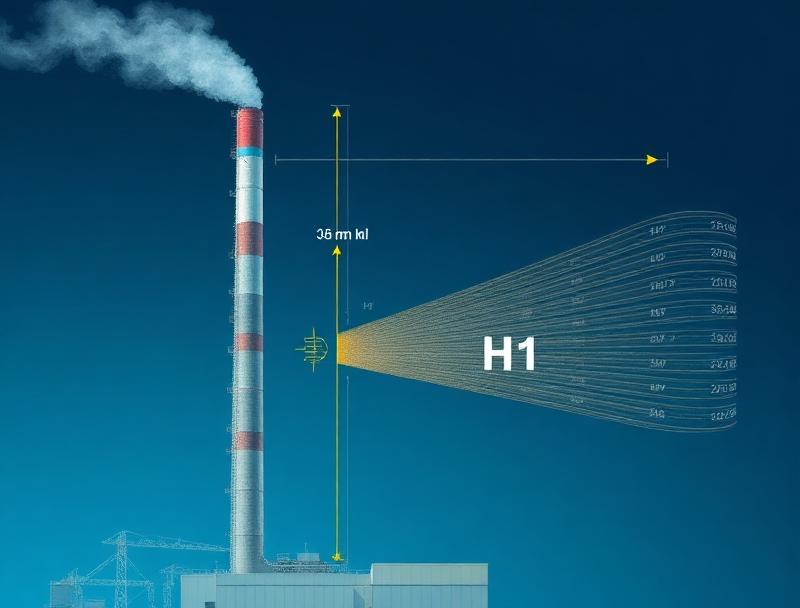
H1 Stack Height Assessment UK (EA D1 Screening)
H1 stack height assessments using EA D1 screening and detailed dispersion modelling to set defensible chimney heights for environmental permit applications.
Build your quote in seconds — our team responds within 1 working hour.
MCERTS stack testing with faster quoting and clearer reporting
Alkali helps operators move from permit condition to completed MCERTS report with less friction: online quote requests, fixed-fee scopes, early-booking discounts, automated reporting workflows and direct access to senior technical staff.
- UKAS Laboratory No. 24303
- MCERTS stack emissions testing
- Online quote requests
- Fixed-fee scopes
- Early-booking discounts for selected services booked at least two months in advance
- Automated Environment Agency-ready reporting
- Direct senior technical support
- Published accreditations and trust signals
Compliance Confidence Included
Pre-submission review, regulator-ready documentation, and 14 days of post-submission query support are included as standard — to reduce refusal risk and enforcement delays.
H1 Stack Height Assessment for EA Permits, D1 Screening and Detailed Dispersion Modelling
An H1 stack height assessment determines the minimum chimney height needed for emissions to disperse safely and meet the Environment Agency's H1 environmental risk criteria. Assessments are required for new bespoke permits, variations, and where existing flues are altered, replaced or relocated. We deliver D1 screening for low-complexity sites and full ADMS-based detailed assessments where buildings, terrain or sensitive receptors mean screening is not appropriate. Outputs are written for the EA, with clear assumptions, model setup and a defensible recommended height. Where modelled emission rates need source data, we pair H1 outputs with our MCERTS stack emissions testing and stack emissions monitoring service.
When an H1 Stack Height Assessment Is Required
- Bespoke EPR permit applications discharging to air
- Permit variations that change emission rate, temperature, velocity or stack location
- Replacement or shortening of an existing flue
- MCP and Specified Generator installations where building downwash or terrain effects apply
- Planning conditions requiring justification of proposed chimney height
D1 Screening vs Detailed Modelling
EA D1 is a screening calculation suitable only for simple, isolated stacks with no significant building or terrain influence. Where buildings within 5L of the stack, complex topography, sensitive receptors or multiple discharge points are present, D1 will under-predict required height and the EA expects a detailed assessment using ADMS or AERMOD with building downwash (PRIME) and appropriate meteorological data.
Methodology and Inputs
- Source data: emission rates, exit velocity, temperature, internal diameter, operating hours
- At least 3 years of representative hourly Met Office MIDAS data for the nearest suitable station
- OS terrain data and building heights/footprints within the influence zone
- Background concentrations from Defra mapped data and any relevant AQMA designations
- Receptor grid plus discrete receptors at residential, ecological and amenity locations
- Comparison of predicted process contribution against EAL/AQAL screening thresholds
What the Report Delivers
- Recommended minimum stack height with sensitivity test on +/- 1 m increments
- Process contribution and predicted environmental concentration tables for each pollutant
- Building downwash assessment and figures showing receptor-by-receptor effect
- Clear EA-ready conclusion: significant or insignificant against H1 criteria
- Modelling files retained for EA review or duly-made checks
What We Need From You to Scope an H1 Assessment
- Site location and a layout plan showing the proposed discharge point
- Plant/process description and operating regime (hours, loads, fuels)
- Proposed or measured emission rates, exit temperature, velocity and stack diameter
- Nearby buildings within the stack-influence zone (heights and footprints)
- Any sensitive receptors, AQMA, SAC/SPA or amenity considerations
- Permit reference and any prior modelling, screening or EA correspondence
What affects stack height
- Emission rate and pollutant type (mass flow and toxicity / EAL of each pollutant)
- Stack diameter, exit velocity and volumetric flow
- Exhaust temperature and resulting plume buoyancy
- Nearby buildings within the stack-influence zone (downwash effects)
- Terrain and topography surrounding the site
- Nearby sensitive receptors (residential, ecological, amenity)
- Process operating pattern (continuous, peaking, intermittent)
- Dispersion risk in the local meteorological context
Worked example: combustion plant on a constrained site
A site installing a new combustion plant may need to demonstrate that emissions are released at a height that supports adequate dispersion to nearby receptors. In a typical case, Alkali reviews the proposed plant, stack details, site layout, surrounding buildings, nearby sensitive receptors and the permit context, then advises whether D1 screening is sufficient or whether a detailed ADMS-based H1 assessment — and, where appropriate, full air dispersion modelling — is required. The output is a defensible recommended stack height with the supporting evidence the Environment Agency expects to see in the permit application.
How H1 links to air dispersion modelling
H1 D1 screening is appropriate only for simple, isolated stacks with no significant building, terrain or receptor influence. Where any of these factors are present, more detailed air dispersion modelling using ADMS or AERMOD is required, typically with PRIME building downwash treatment and at least three years of representative met data. In practice, most industrial sites move beyond D1 screening into a full modelled H1 assessment, which is delivered alongside the modelling report so the application is duly-made on first submission.
Related permitting and modelling services
H1 stack height assessments are commonly paired with ADMS air dispersion modelling where D1 screening indicates further work, and form part of broader H1 environmental risk assessments for new permits. The same calculations underpin Medium Combustion Plant permit applications and full environmental permit applications, with downstream evidence delivered through our MCERTS stack emissions testing across the UK. To scope an assessment, request a fixed-fee quote or discuss your permit requirements with a senior consultant.
Frequently Asked Questions
When does the EA accept D1 screening instead of detailed modelling?
Only where the stack is more than 5 stack-heights from any influencing building, terrain is flat, and there is a single discharge point with no nearby AQMA or sensitive ecological receptor. In practice most industrial sites require detailed ADMS modelling.
What height increase triggers a permit variation?
Any change to the agreed stack height, location or efflux parameters listed in the permit requires a variation. Even shortening a stack can require a fresh H1 assessment because dispersion characteristics change.
Which meteorological dataset should be used?
At least three full years of sequential hourly Met Office MIDAS data from the closest representative station, including cloud cover. Site-specific met data is acceptable where it has been QA-checked and covers the same period.
How are short-term peaks handled in the assessment?
Short-term EAL comparisons use the relevant percentile (e.g. 99.79th for 1-hour NO2). The model is run for each year of met data and the worst-case year is reported alongside the long-term annual mean.
Can the assessment cover multiple stacks together?
Yes. Multi-source modelling is required where stacks are close enough for plumes to interact, and is the only way to demonstrate cumulative impact at receptors for the H1 conclusion.
Do you produce the H1 spreadsheet for the EA submission?
Yes. The completed H1 air emissions risk assessment spreadsheet is produced alongside the modelling report so the application is duly-made on first submission.
What is H1 stack height determination?
H1 stack height determination is the Environment Agency methodology used to set an appropriate release height for emissions to air. It supports environmental permit applications and variations by demonstrating that the proposed chimney height allows emissions to disperse to acceptable concentrations at sensitive receptors, using D1 screening for simple sites or detailed ADMS-based modelling for more complex ones.
How is stack height calculated in the UK?
Stack height is calculated using either H1 D1 screening for isolated stacks with no significant building or terrain influence, or detailed dispersion modelling (ADMS or AERMOD with PRIME) for sites with nearby buildings, terrain effects or sensitive receptors. The calculation considers emission rate, exit velocity, exhaust temperature, stack diameter, surrounding buildings, terrain and met data.
When is stack height evidence needed for an environmental permit?
Stack height evidence is needed for new bespoke environmental permits with emissions to air, for variations that change emission rate, temperature, velocity or stack location, when a flue is replaced or shortened, for MCP and Specified Generator installations, and where planning conditions require justification of the proposed chimney height.
Is stack height linked to dispersion modelling?
Yes. Stack height directly drives modelled ground-level concentrations at nearby receptors. Where D1 screening shows further work is needed, the H1 assessment is delivered through detailed air dispersion modelling, with sensitivity tests on height, velocity and temperature to identify the minimum compliant configuration.
What information is needed for a stack height assessment?
Process description, emission point details, site layout, stack dimensions, emission data (rate, temperature, velocity, diameter), nearby sensitive receptors, nearby building heights and footprints within the influence zone, permit or planning context, and the regulatory deadline. Alkali provides a scoping template to capture this in one pass.
Can Alkali support both stack height and permit work?
Yes. Alkali delivers H1 stack height assessments alongside MCP permit applications, environmental permit applications, H1 environmental risk assessments and the downstream MCERTS stack emissions testing once the plant is operational — managed as a single, fixed-fee workstream.
Get a fixed-fee MCERTS stack testing quote online
Add the services you need, upload your permit conditions, and Alkali will review the scope and respond with a clear proposal — no phone tag, no email chains. A former Environment Agency officer reviews every brief for accuracy before pricing.
- Fixed-fee MCERTS scope
- Former EA officer review
- Response within one working day
Online quoting reduces admin, avoids repeated emails, and helps operators get a faster, more accurate scope.
You May Also Need

Air Dispersion Modelling UK (ADMS & AERMOD)

Environmental Permits UK – EA Applications & Support
Environmental Risk Assessments (H1, SCAIL, D1)

MCERTS Stack Emissions Testing UK | UKAS Lab 24303
Services that often include H1 Stack Height Assessment UK (EA D1 Screening):
Need a Quote for H1 Stack Height Assessment UK (EA D1 Screening)?
Add this service to your quote and submit a request. We'll review your scope and get back to you within 24 hours.